icon

Office

Mon - Sat, 9:00 AM - 7:00 PM

icon

Your Email

sales@sancosteels.com

preet@sancosteels.com

icon

Address

Mumbai-400004.
Maharashtra, India.

Ferrule Fittings for Marine & Shipbuilding: Why They Are a Reliable Choice

  • Home
  • >
  • Blog
  • >
  • Ferrule Fittings for Marine & Shipbuilding

Ferrule Fittings for Marine & Shipbuilding: Why They Are a Reliable Choice

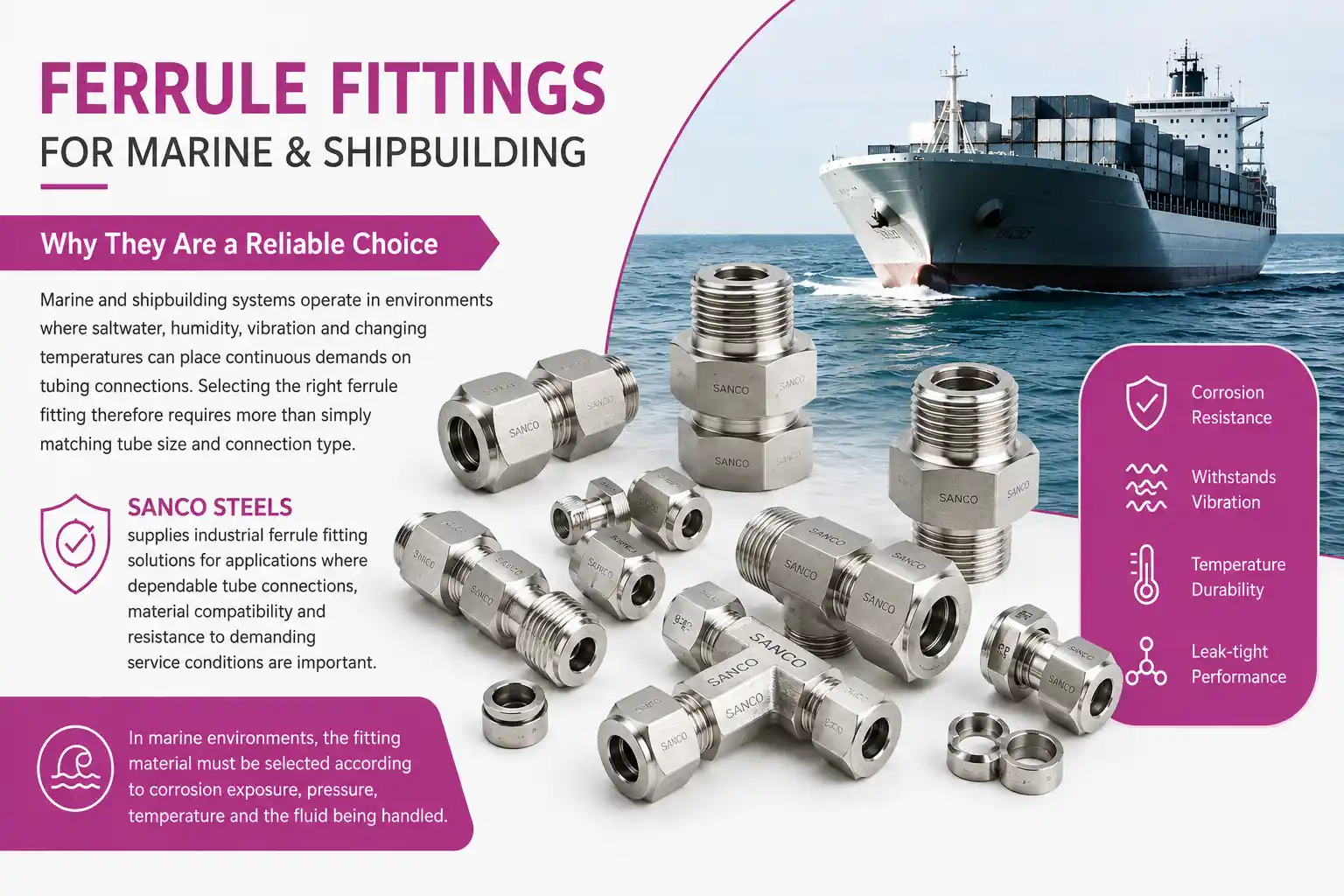
Marine and shipbuilding systems operate in environments where saltwater, humidity, vibration and changing temperatures can place continuous demands on tubing connections. Selecting the right ferrule fitting therefore requires more than simply matching tube size and connection type.

Sanco Steels supplies industrial ferrule fitting solutions for applications where dependable tube connections, material compatibility and resistance to demanding service conditions are important. In marine environments, the fitting material must be selected according to corrosion exposure, pressure, temperature and the fluid being handled.

Ferrule fittings for marine and shipbuilding applications

Why Are Ferrule Fittings Used in Marine Applications?

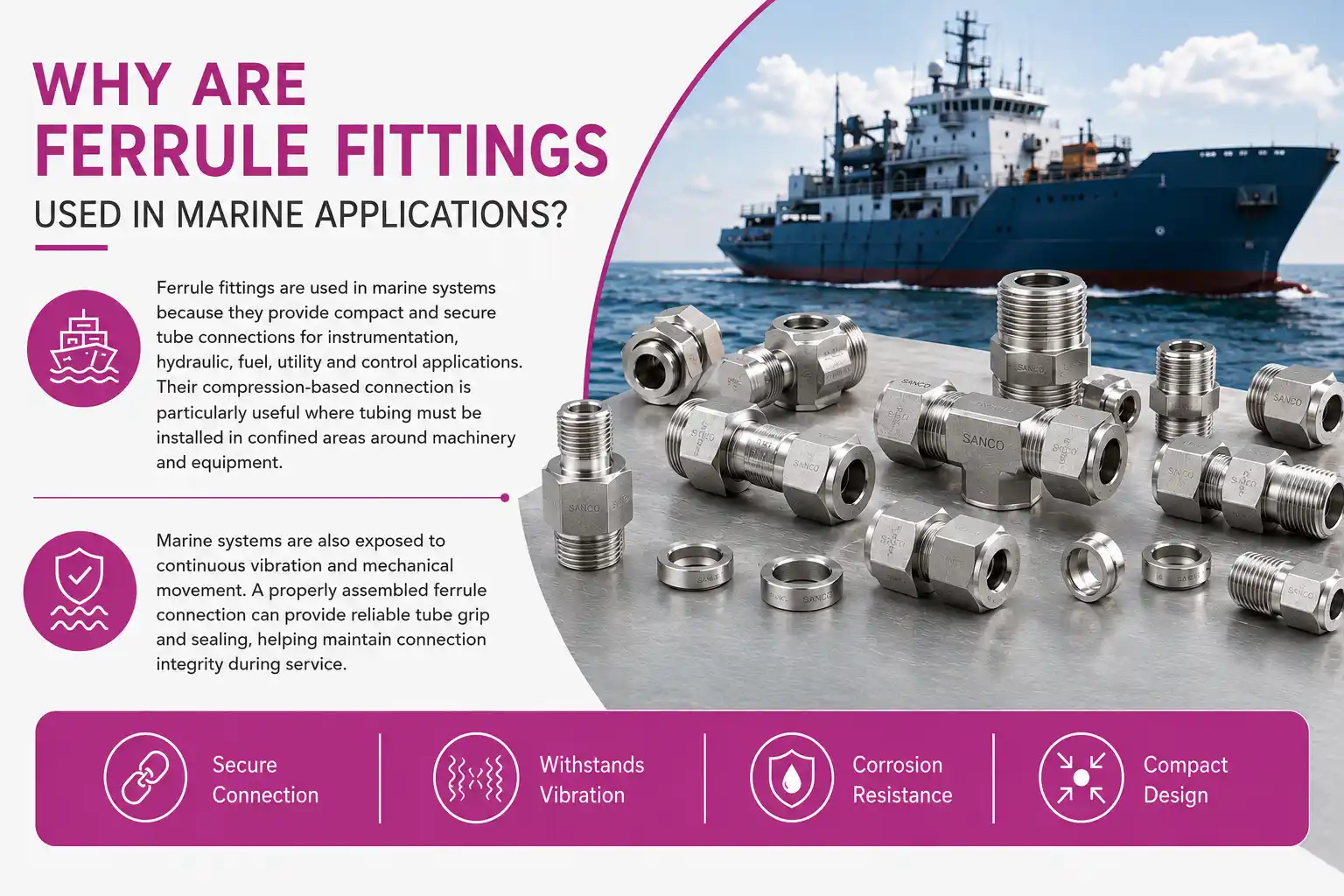
Ferrule fittings are used in marine systems because they provide compact and secure tube connections for instrumentation, hydraulic, fuel, utility and control applications. Their compression-based connection is particularly useful where tubing must be installed in confined areas around machinery and equipment.

Marine systems are also exposed to continuous vibration and mechanical movement. A properly assembled ferrule connection can provide reliable tube grip and sealing, helping maintain connection integrity during service.

Key Reasons Marine Systems Use Ferrule Fittings

  • Compact construction for restricted installation areas
  • Secure tube connections for fluid and instrumentation lines
  • Suitable for vibration-prone systems
  • Practical for maintenance and servicing
  • Available in materials for different corrosion conditions

Another important consideration is the marine environment itself. Saltwater, moisture and chloride exposure can accelerate corrosion, so the material of the fitting becomes an important part of the overall system specification.

Where Are Ferrule Fittings Used in Marine & Shipbuilding?

Ferrule fittings can be incorporated into a range of shipboard and offshore tubing systems. The exact application depends on the vessel design, equipment and service conditions.

Common Marine Applications

  • Engine-room instrumentation and pressure monitoring
  • Fuel and lubrication tubing
  • Hydraulic control systems
  • HVAC and utility control lines
  • Seawater cooling circuits
  • Ballast and firewater systems

On offshore vessels and marine installations, similar connections can be required around hydraulic equipment, control panels, instrumentation systems and other fluid-handling equipment.

The compact nature of ferrule connections makes them practical where tubing needs to be routed around machinery, panels and other equipment with limited available space.

Which Materials Are Suitable for Marine Ferrule Fittings?

Marine service does not require one universal fitting material. The right option depends on the level of corrosion exposure, operating temperature, pressure, process media and expected service life.

Stainless Steel Ferrule Fittings for Marine Applications

Stainless steel is a practical choice for many marine systems because it offers a useful combination of corrosion resistance, strength and durability. It can be considered for shipboard instrumentation, hydraulic systems, utility tubing and other applications where the environment is corrosive but does not require a more specialized nickel alloy.

For general marine and shipbuilding requirements, Stainless Steel Ferrule Fittings can provide a dependable option when the appropriate grade is selected for the service conditions.

Monel Ferrule Fittings for Seawater Service

Continuous exposure to seawater creates more demanding corrosion conditions than many general shipboard environments. Monel is therefore considered for applications where enhanced resistance to seawater and chloride exposure is important.

This can make Monel Ferrule Fittings suitable for selected seawater, offshore and marine equipment applications where long-term corrosion resistance is a major consideration.

Inconel Ferrule Fittings for Demanding Conditions

Some marine and offshore systems operate under a combination of elevated temperatures and aggressive corrosion conditions. In such cases, nickel-based materials can offer characteristics that make them suitable for more specialized service environments.

For these demanding applications, Inconel Ferrule Fittings may be considered where both corrosion resistance and high-temperature performance influence the material specification.

Ferrule fittings used in marine applications for secure tube connections

Ferrule Fittings for Seawater & Corrosive Marine Environments

Seawater exposure is one of the most important factors to consider when selecting metallic tubing components for marine service. Chlorides, persistent moisture and salt deposits can contribute to corrosion when an unsuitable material is used.

Marine Environments Can Involve

  • Saltwater and chloride exposure
  • High humidity and condensation
  • Salt spray on exposed equipment
  • Continuous wet and dry cycles
  • Offshore weather conditions

Material selection should therefore be based on the actual service environment, rather than assuming that the same ferrule fitting material is suitable for every marine application.

Ferrule Fittings for Shipbuilding: Key Selection Factors

Shipbuilding applications often involve many different tubing systems, so the ferrule fitting should be selected according to the requirements of the individual circuit.

Before Specifying the Fitting, Consider

  • Tube outside diameter and wall thickness
  • Operating pressure
  • Operating and ambient temperature
  • Fluid or gas being handled
  • Saltwater or corrosive exposure
  • Vibration and mechanical movement
  • Tube-to-fitting material compatibility
  • Required connection and thread specification

For example, a fitting used on a general instrumentation line may have different material requirements from one operating continuously in a seawater environment.

What Should Buyers Check When Sourcing Marine Ferrule Fittings?

For marine and shipbuilding projects, purchasing decisions should consider more than dimensions and price. The supplied fitting should match the engineering specification and the intended service environment.

Before Placing an Order, Verify

  • Material grade and specification
  • Tube and fitting compatibility
  • Size and connection type
  • Pressure and temperature requirements
  • Required inspection or testing
  • Material certificates and traceability
  • Applicable project or industry specifications

Working with a supplier such as Sanco Steels can also help buyers identify the appropriate material and configuration according to the intended marine application.

FAQs

Why are ferrule fittings used in marine applications?

They provide reliable tube connections in systems exposed to vibration, pressure and moisture, while their compact design suits confined shipboard installations.

Can ferrule fittings be used in seawater systems?

Yes. They can be used when the fitting material is compatible with seawater and its chloride-rich environment, particularly in cooling and utility systems.

Which ferrule fitting materials are suitable for shipbuilding?

Stainless steel is suitable for many general marine systems, while Monel or Inconel may be selected where seawater corrosion or more demanding operating conditions require specialized materials.

Are ferrule fittings suitable for shipboard instrumentation?

Yes. Their compact compression design makes them practical for pressure, control and instrumentation tubing installed around engines, equipment and control panels.

What factors affect the service life of marine ferrule fittings?

Proper material selection, tube compatibility, correct installation, operating conditions and exposure to seawater or other corrosive media can all affect fitting service life.

What should buyers check before sourcing marine ferrule fittings?

Buyers should verify the material grade, tube dimensions, pressure and temperature requirements, connection type, applicable specifications and required material documentation before ordering.

Source Certified Ferrule Fittings for Your Marine Project

Working with a supplier such as Sanco Steels can help buyers identify the appropriate material and configuration according to the intended marine application. Contact our sales team today for a custom bulk pricing quote.